Happy May!

Original picture on Flickr
It’s going to be May in a couple of days… so here you go :)
Labels: macro photography, macrography, photography, wallpaper
posted by Hypnos @ 1:20 pm
0 Comments


Advertising, Marketing, Strategy and Photography
Labels: macro photography, macrography, photography, wallpaper
posted by Hypnos @ 1:20 pm
0 Comments
 Get a tube of superglue and a short stick-like metallic object - I used a simple paper pin. Now unscrew just the female mount from the tube (it is the mount resembling the one on your body, on which the lens would mount), and mount one of your lenses on it. Now when you see the open (mounted) end of the lens and the mount-ring, you’ll see a lever (see diagram) protruding from the lens’s base - this is the same lever that adjusts your aperture as mentioned in the previous tutorial. Use a permanent marker or a chalk to mark the position of this lever on the ring when this lever is fully depressed, i.e. the aperture is wide-open.
 When dried, the ring would look like the picture shown here.
 Here’s a shot that I clicked using this setup. And don’t forget to drop in URLs to the photographs you’ve clicked this way.
Labels: cheap, DIY, howto, macro photography, macrography, photography, SLR, tutorial, walkthrough
posted by Hypnos @ 12:37 am
0 Comments
 You must have read that reversing the lens enables you to get high magnification - to the extent of 1:1 (which is where true macrography begins). So how do you go about doing it? Here's how.
 First up you will need a reversing ring. It is a ring with a male mount on one side, just like your lens's mount, which would click into your body's mount and male threads on the other end, which would screw into your lens's filter threads. Check the picture to see what it looks like.
 , ask for an extension tube for your brand. If you don't get it at an authorised camera store, go to the local photography market, where people go to buy and sell second-hand equipment - the unorganised market. It is a pretty low-cost item. I got my extension tube set for Rs. 600 only. Here is what an extension tube set looks like. The ring we need is an integral part of the extension tube, so if you bought an extension tube, just unscrew the ring that is supposed to be attached to the body's mount, and you have your reversal ring.
 because we need to focus by hand. Now go to your menu and change the settings of your body flash to manual from TTL (through-the-lens) mode - set the power of the flash at around 1/4 or 1/8. Finally, set the focal length of your kit lens around between 40 and 50. Any higher than that and you'll be getting 'normal' magnification. You can go lower than that once you get the hang of this method and are comfortable going really close.
 focus by rotating the main barrel (marked B in the picture). Since the effective focusable zone is smaller and much closer to the lens when the lens is reversed, you might see that whichever way you turn the lens, nothing comes in focus. In that case, move closer. You will have to move back and forth quite a lot to get objects in focus. Experiment with the shutter speed. I generally use between 1/5 to 1/200 (a limitation of my camera while using flash).
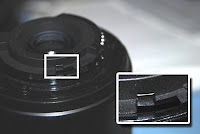 the aperture lever on the mounting side of the lens (see the figure) to open it up, and you'll see light! This way you get enough light to be able to see the shot clearly, focus properly and ofcourse with so much light coming in, the pictures are also great! One problem we still face is that the more we open the aperture, the narrower the depth-of-field, and this is evident at this scale. Plus, when the aperture is this wide and you are using the flash, pictures might be overexposed. Either reduce the power of the flash, or lower the aperture size a bit just before releasing the shutter.
 Take care to not block the flash with your fingers/hand while focusing and operating the aperture lever. Unwanted shadows are the last thing you'd want in your photograph.
Labels: cheap, DIY, howto, macro photography, macrography, photography, SLR, tutorial, walkthrough
posted by Hypnos @ 7:23 pm
2 Comments
Subscribe to
Posts [Atom]
